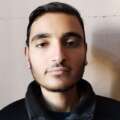

I was displaced to Khan Younis after fleeing from death itself. I left my home knowing that staying could mean not surviving the night. There was no time to think—only the need to move, to escape. The road was full of fear and exhaustion. Children crying. Adults pretending to be strong. Every step, the same question: would we make it, or would the road end before we did?
I don’t remember what number this displacement was. First, second, tenth… numbers stopped meaning anything. We just moved, from one place to another, carrying our lives in plastic bags, leaving pieces of ourselves behind each time. We chased safety, but it never stayed long enough to call it peace.
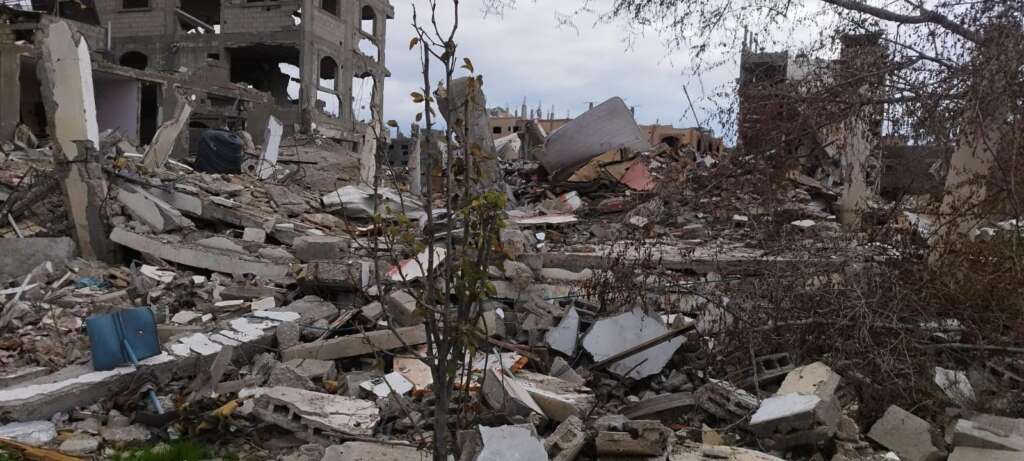
Even when the war was said to be over, it never really ended for us. The sky still dropped fragments of shells without warning. Buildings stood wounded, still shot, still broken, as if violence had frozen in their walls. There was no line between war and after-war. Fear lived in the air, in the silence, in the nights when every sound felt like a threat.
In Khan Younis, we lived beside piles of rubbish that smelled like death. The stench wrapped around us every day, heavy and suffocating, making it hard to breathe, hard to forget where we were. And above it all, the bombing never stopped. Strikes shook the ground beneath our feet, reminding us that safety was only a word we used to know.
We did not live—we waited. We waited for calm, for certainty, for a place that would not force us to run again. Displacement became a state of being, not a momen”. Home was no longer a place; it was a memory we carried while moving, always moving, hoping the next stop would finally let us rest.
When the war finally ended, we returned to our neighborhood in Al-Zaytoon, hoping—foolishly—that peace would be waiting. It wasn’t. The shooting never stopped. The shells kept falling, as if the war refused to let go of us.
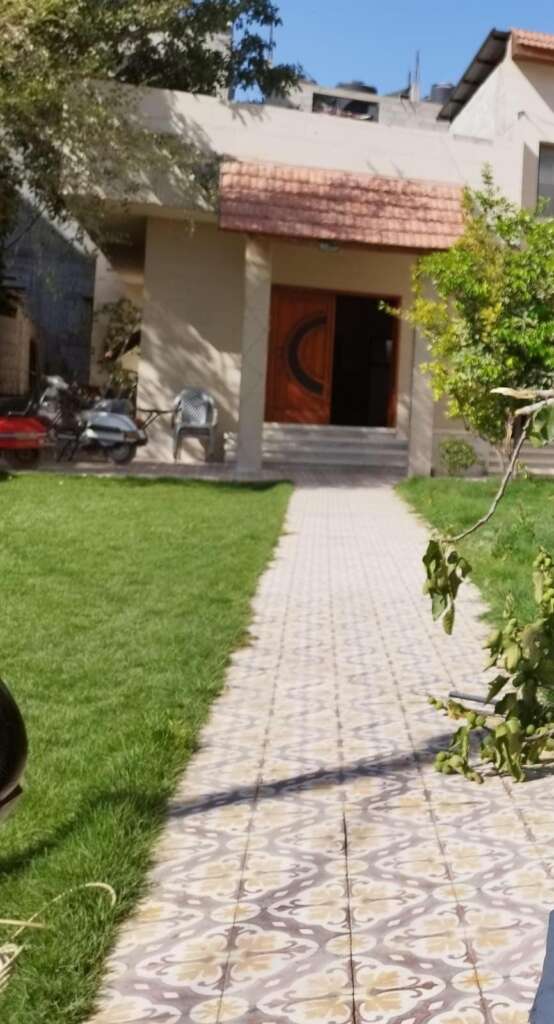
Our home was gone. I used to live in a big house, a place that felt endless when I was a child. I had my own room—a small world that belonged only to me. The house was alive then, surrounded by olive trees, steady and ancient. Red roses bloomed beside the gate. A jasmine tree caught the sunlight, its scent arriving before you even saw it. The courtyard was soft with grass, and along the edges grew basil and mint—plants I watered every day, rubbing the leaves between my fingers just to breathe them in.
Now all of it was destroyed. Our house was marked inside the yellow zone—off-limits, dangerous, untouchable. A place that once held our lives was suddenly forbidden. We stood close enough to remember everything, but too far to return. That distance hurt more than the ruins themselves.
Yet life went on—or we tried to push it forward. Not because we were strong, but because stopping felt impossible. Neighbors disappeared without a word. One day they were there; the next, their houses were gone, and so were they. Families torn apart in moments. Friends vanished under the sound of bombs, leaving only silence where laughter once lived.
Every day felt like the sky was falling closer—not just on our homes, but on our hearts. Hope became small and fragile, something we hid so it wouldn’t be taken. Nights were long, filled with fear and waiting. Waiting for the next explosion. Waiting to see who would be gone in the morning.
And still, we wake up. We stand in lines. We search for water, for bread, for news that isn’t death. We hold our children and pretend we are not afraid. We keep living not because we are brave, but because survival leaves no choice. After a while, staying alive stops being a choice—it becomes a quiet refusal to disappear.
I have seen death everywhere I go—during war, during ceasefire, in movement and in stillness. If the bombs do not kill us, hunger tries. If hunger fails, disease waits. If we survive all that, fear finishes the work. We are trapped between different kinds of death, with no escape. Even peace feels dangerous when it is surrounded by ruins and silence.
And still, I hope.
I hope for a life where my existence is not an act of resistance.
I hope for mornings that arrive quietly, without fear.
I hope to breathe without reminding myself that breathing is a victory.
I hope to return home—not to ruins, not to memories, but to a place where I belong.
I hope for safety that feels ordinary, not borrowed or temporary.
I hope to live with dignity. I hope my humanity is not questioned, my pain not denied. I hope to rebuild—not only houses, but trust, childhoods, and futures. I hope for days filled with ordinary things: laughter, routine, love, silence.
Above all, I hope to live fully—not just endure, but grow, dream, rest. To be human, without apology.
Fadel Kishko is a Gaza-based writer focused on themes of survival, memory, and human dignity.
Note: This project is supported by the British Council as part of the SARD programme, which focuses on the role of English and other languages in building resilience. SARD – Stories of Adversity, Resilience and Determination – encourages Palestinians, particularly young people, to share their stories and lived experiences through creative and educational media. The content of this production is solely the responsibility of Resilient Voices and does not necessarily reflect the views of the supporting or partnering institutions.