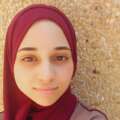
Hedaya was a quiet, thoughtful girl in eighth grade. She lived in Gaza with her parents and three younger siblings: Sara in sixth grade, Nour in fourth, and Ahmad in first. Their home was modest—filled with laughter, books, and simple dreams. Hedaya’s biggest dream was to become a teacher. She loved explaining things and watching her siblings learn. She was a simple girl, but her heart carried big hopes—hopes of one day standing in front of a classroom, inspiring children, and making her parents proud.
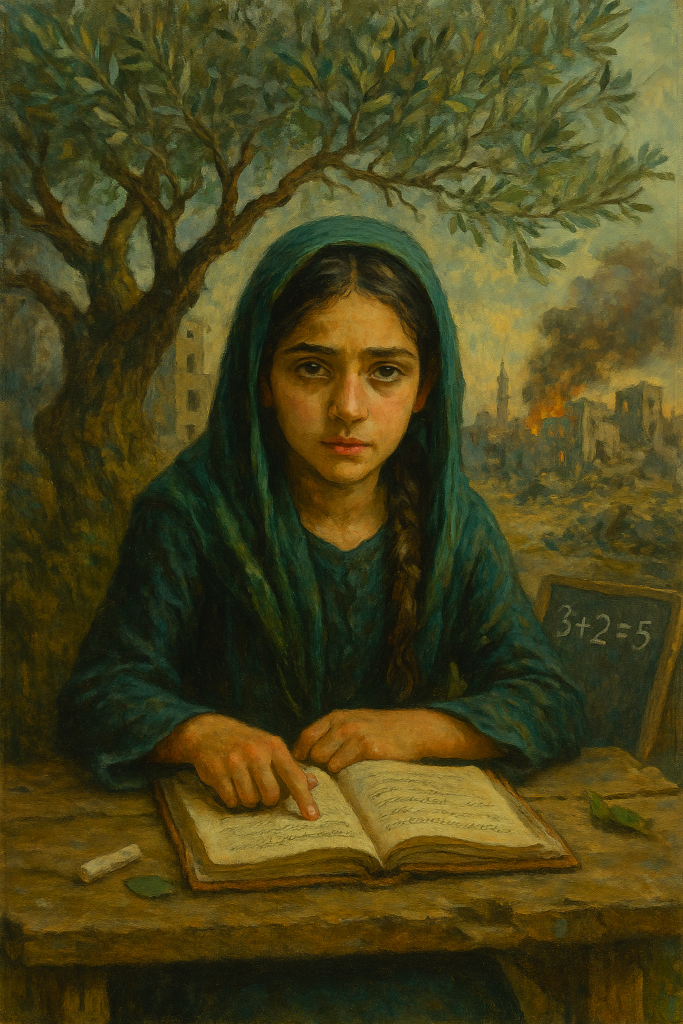
Her neighborhood was surrounded by schools, markets, and olive trees. The air often smelled of fresh bread. But everything changed when the war came. The streets emptied. The sky darkened. And the sound of learning was replaced by silence.
One morning, the school bell never rang. The war had begun. Schools closed. Teachers disappeared. Internet stopped. Hedaya and her siblings stayed home, confused and frightened. Days turned into weeks. Weeks into months. Education vanished. Their mother tried to keep their spirits alive—cooking their favorite meals, helping with lessons, and comforting their father with words of faith and encouragement.
But Hedaya didn’t give up.
She found old notebooks in a drawer—dusty, torn, but filled with grammar rules, math problems, and science diagrams. She cleaned them, rewrote lessons, and turned their living room into a classroom. She taught Sara, Nour, and Ahmad how to read, write, and count. She used chalk on cardboard, sang songs to explain grammar, and invented games to keep them focused.
Their mother watched with pride. She often said, “You were born to teach, Hedaya.”
One afternoon, their mother went out to buy bread and medicine. A nearby explosion shook the house. Hedaya ran to the window. Smoke filled the sky. Hours passed. Her mother didn’t return.

Later that night, they learned the truth. A sharp piece of metal from the explosion had taken her life.
The blast had also damaged their home severely. Walls cracked. Windows shattered. Their safe space was no longer safe. The family had to move to their relatives’ house for a while, hoping the danger would pass and peace would return—peace that every innocent child deserves, just to live, dream, and make their parents proud.
Hedaya was only thirteen. But from that moment, she became more than a sister—she became a second mother.
She cooked simple meals with love. She whispered words of comfort to her siblings. She hugged them when they cried. And every night, she opened the Qur’an, reading verses aloud to strengthen her heart. Her faith became her anchor. She believed that Allah was watching from above, that He knew their pain, and that something beautiful awaited them in the future.
Her father, though broken, stood beside her. He worked long hours and returned exhausted, but Hedaya greeted him with warm food and hopeful words: “Don’t worry, Baba. We will be okay. Allah is with us.”
She tried to ease his burden with kindness and strength. She reminded him, “There is something beautiful waiting for us. Allah sees everything. He knows what we suffer. He will help us.”
Even when food was scarce and hunger visited their home, Hedaya kept going. She believed her mission was sacred: to teach, to survive—not just for her siblings, but for the future she still believed in.
She was the fruit her mother had raised with love—and now, she was planting a garden of hope.
One day, another explosion shattered the window where Hedaya used to sit and gaze longingly at the silent school across the street. Glass covered the floor. Her classroom was gone. But she didn’t stop.
She continued teaching in the narrow corridor, turning every corner of the house into a space for learning. She drew on the walls. She whispered stories by candlelight. She taught through fear, hunger, and silence.
She was no longer just a student. She was a teacher, a sister, a mother, and a believer.
The ink she clung to—the ink of old notebooks, of handwritten lessons, of verses copied by candlelight—was what saved her siblings from ignorance. It was that ink that kept them from growing up without knowledge, without guidance, without light.
Two years passed. No school. No teachers. No internet. But Hedaya taught every single day. Her siblings learned. They grew. They dreamed.
She knew that school was not just a building. It was a place where children built their character, learned beautiful values, and discovered knowledge that had no price. Without education, we remain in the same place—unable to grow, to change, or to lift our society. But with it, we rise.
Then, one morning, the radio announced: “Schools will reopen next week.”
The children screamed with joy. Their father hugged them tightly. Hedaya smiled, holding her mother’s scarf close to her heart.
But the return to school was not what she had imagined.
Many families who had lost their homes or lived in unsafe areas had been sheltering inside school buildings. Now, they were asked to leave so students could return. These displaced families moved into tents—thin, worn fabric stretched across courtyards, sidewalks, and empty lots. Hedaya passed by them on her way to school: children playing with stones, mothers cooking over small fires, fathers building makeshift walls from cardboard and wood.
Inside the school, the classrooms were overcrowded. More than fifty students squeezed into each room. Some sat on the floor. Others stood the entire lesson. The windows were broken. The walls were cracked. The blackboard was half-burned. Teachers tried to teach through the noise, and students tried to learn through exhaustion.
Hedaya sat quietly in the corner, clutching her notebook and her mother’s scarf. She knew education had returned—but it had returned wounded, overwhelmed, and fragile.
Still, she didn’t lose hope.
“If I could teach in a hallway,” she thought, “I can learn in a crowded room.”
During breaks, she gathered younger students and helped them understand the lessons. She drew diagrams on the ground. She explained grammar with songs. She became a teacher again—this time inside the school itself.
“We don’t need perfect walls to dream,” she said. “We just need a heart that believes, a notebook, and a pencil.”
And so Hedaya kept teaching, kept learning, kept believing.
Her story was not finished. It was only beginning. Somewhere beyond the broken classrooms and the cracked walls, a future was waiting—one she had yet to write, with ink, with faith, and with hope.
Hedaya has big dreams. Will her struggles continue to develop her into something extraordinary…
This is the story of Hedaya, a girl from Gaza. Sadly, there are many stories like hers—children who carry burdens too heavy for their age, who survive wars that know nothing of mercy, and who still choose to rise.
Fatma Majed Salha is a 21-year-old senior student of English at Al-Aqsa University. Born and raised in Gaza, she has lived through the painful realities of war, experiences that shaped her resilience and strengthened her spirit. These challenges became the foundation of her creative journey, inspiring her to express herself through writing and to transform hardship into stories of hope and endurance.
This is the story of Hedaya, a girl from Gaza. Sadly, there are many stories like hers—children who carry burdens too heavy for their age, who survive wars that know nothing of mercy, and who still choose to rise.
Fatma Majed Salha
Fatma Majed Salha is a 21-year-old senior student of English at Al-Aqsa University. Born and raised in Gaza, she has lived through the painful realities of war, experiences that shaped her resilience and strengthened her spirit. These challenges became the foundation of her creative journey, inspiring her to express herself through writing and to transform hardship into stories of hope and endurance.
Note: This project is supported by the British Council as part of the SARD programme, which focuses on the role of English and other languages in building resilience. SARD – Stories of Adversity, Resilience and Determination – encourages Palestinians, particularly young people, to share their stories and lived experiences through creative and educational media. The content of this production is solely the responsibility of Resilient Voices and does not necessarily reflect the views of the supporting or partnering institutions.