



I am one of thousands of Palestinian students who have been abruptly stripped of our classrooms, books, teachers—and certainty about the future. I write these words from Gaza, where education has shifted from a guaranteed right to a fragile hope. For more than two years, prolonged hostilities have devastated civilian life. Schools have been damaged or destroyed, and universities that once fostered learning and debate are now largely inoperable.
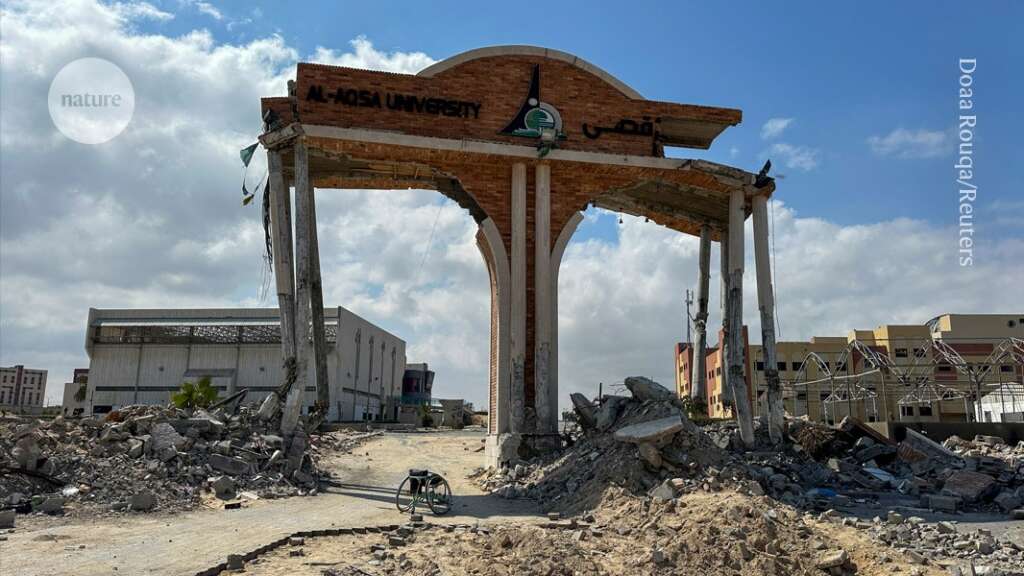
The dreams we once carried—earning degrees, building careers, contributing positively to society—have been overshadowed by a daily reality shaped by displacement, loss, and insecurity. Education, once a source of stability amid uncertainty, now feels distant and elusive.
University Students: When Learning Competes With Survival
For students in Gaza, pursuing education has become increasingly difficult. Universities that once thrived as centers of intellectual life now stand damaged or silent. Students are forced into painful trade-offs: attending an online lecture or searching for clean water; completing coursework or caring for younger siblings who have lost parents.
Electricity and internet access are no longer basic tools for learning—they have become scarce lifelines. The cost of charging a phone or laptop can exceed what a family earns in days. Many students navigate unsafe, damaged streets in search of connectivity, gathering in informal spaces simply to remain connected to their studies. These makeshift learning environments are precarious, and when they are disrupted by ongoing violence, the loss is profound. The lives affected are not only those of students, but of future teachers, engineers, writers, and innovators.
Our grades have been replaced with grief.
Our classrooms replaced with places of mourning.
Education Under Siege: The Fragility of Knowledge in War
The damage to Gaza’s education system is extensive. More than 70 percent of educational infrastructure has been damaged or destroyed, with some recent UN assessments estimating that nearly all school buildings have been affected.
Higher education has suffered particularly severe losses. At least thirteen universities have sustained direct damage, including the Islamic University of Gaza, Al-Azhar University, and Al-Aqsa University. According to UNESCO, most higher-education institutions in Gaza have been damaged or rendered inoperable, resulting in the loss of faculties, laboratories, libraries, and academic archives.
Libraries, cultural centers, and student spaces—places that once provided intellectual refuge—have also been impacted. Each loss extends beyond physical structures, disrupting continuity of learning and weakening the transmission of knowledge across generations. The consequences are not only material but intellectual, affecting present students and future scholars alike.
Stranded Scholars: Opportunities Beyond Reach
Thousands of students from Gaza who earned scholarships and university placements abroad remain unable to leave. Border crossings are frequently closed or tightly restricted, and exit permissions are denied.
I personally received offers to study at top universities in the UK and Ireland—opportunities built on years of dedication and academic effort. Yet these opportunities remained inaccessible, not because of academic failure, but because movement itself became impossible.
Many students continue to wait with expiring offers or deferred admissions. Some have already lost their place entirely. It is difficult to explain to a young person how an earned future can remain just beyond physical reach. We are encouraged to remain patient, but patience alone cannot overcome closed borders.
Educators Lost: Knowledge That Cannot Be Replaced
Hundreds of educators have been killed during the conflict, with some education-sector sources reporting more than 600 teachers and academic staff lost by early 2025. These individuals were not only instructors, but mentors, researchers, and custodians of collective knowledge.
Schools that remain standing face acute shortages of qualified teachers. At universities, research activity has largely halted. Specialized expertise in medicine, engineering, literature, and science has been diminished with the loss of those who carried it forward.
The absence of educators represents a loss that extends far beyond statistics—it reshapes what future education can look like.
Global Silence and a Call for Support
Despite the scale of devastation, the collapse of education in Gaza is often treated as secondary to other humanitarian emergencies. Yet UN agencies and human-rights experts have repeatedly warned that Gaza’s education system is nearing total collapse.
We are not asking for immediate reconstruction. We are asking for survival measures: emergency digital access, free or subsidized connectivity, flexible scholarship policies, psychosocial support, academic evacuation pathways, and international recovery programs for displaced and stranded students.
Education remains one of the few protections against despair, isolation, and long-term instability.
A Final Appeal: Protecting the Right to Learn
We are more than numbers.
We are more than ruins.
We are more than victims of circumstance.
We are students who study by candlelight. Who teach younger siblings between moments of fear. Who continue to imagine graduation even when our schools no longer exist.
This is not only a request for aid—it is a call for recognition. War destroys buildings quickly, but the erosion of minds and futures lasts far longer. Education must not be allowed to disappear quietly.
A scholarship can reopen a future.
A single act of solidarity can affirm that learning still matters.
We write, we speak, we reach out—because we still believe.
Please do not let those voices fade into silence.
*************
Hasan Abdelqader is a dedicated English teacher and trainer based in Gaza. A graduate of the English Department at Al-Aqsa University, he brings a strong academic foundation and a passion for language education to his work.
Note: This project is supported by the British Council as part of the SARD programme, which focuses on the role of English and other languages in building resilience. SARD – Stories of Adversity, Resilience and Determination – encourages Palestinians, particularly young people, to share their stories and lived experiences through creative and educational media. The content of this production is solely the responsibility of Resilient Voices and does not necessarily reflect the views of the supporting or partnering institutions.


2 Comments
Mustafa Hussein
A great article that talks about an important topic that needs to be addressed urgently.
AbdAllah
Education is a cornerstone to building a functioning, industrious society. inshaAllah, despite the hardships, we as believers can connect and help rebuild the systems of education in Gaza. May Allah grant success to the patient, and those with haste in good works.