



At the beginning of the war, Rafah, a city almost erased from the map, became a refuge for over a million people. I cannot forget those early days… the days of pain from losing my dearest friends, the first among them. I was still living in my home, searching for hope in the news, hoping to hear that the war might end less than a month after it began.
I was sitting with my little brother, Mohammad, and my mother, while my father had gone out for some necessities. Then a huge explosion shook the neighborhood, shattering the windows. Smoke and ash spread everywhere, and screams filled the air. I called out for Mohammad, ran to reassure him, and thanked God we were safe. I thought about how just days ago I had been in my home, and now our shelter was a simple tent with a roof of cloth.
I heard my mother calling, worried for my father, who had gone out. Torn between checking outside or comforting her, I ran toward the door and discovered that the bombing had targeted our neighbor Abu Yusuf’s house, Yusuf, my childhood friend. The house was almost a pile of stones. Neighbors carried Yusuf and his father to ambulances; I tried to help with the rest of his family, but my body felt weak, unable to move. I did not know whether to scream, cry, or feel relief at surviving.
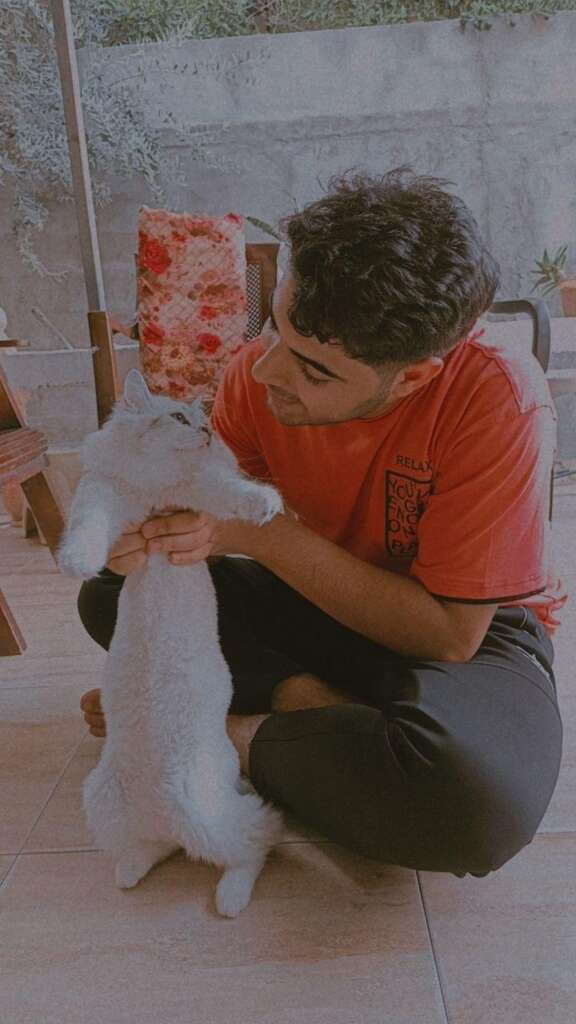
That night, after attending their funeral, my bed became a refuge to cry over everything that had happened. The next day, I went to the ruins of Yusuf’s house, recalling childhood memories with him and his family. And then, I noticed movement under the rubble… Leo, Yusuf’s little cat. Hurt but alive, she brought a small spark of hope on the day the war truly began for me. Suddenly, I felt a slight movement around me… Something was moving under the rubble. I searched a little and found Leo, Yusuf’s little cat. I had always played with her; her eyes seemed to cry as if calling for help, and she had some wounds. I quickly picked her up, hugged her, and felt as if I had found Yusuf’s spirit in her. I went home swiftly, gave her some milk to drink, and began tending to her, washing away the traces of the rubble. She began to recover, and I felt that she enjoyed coming to my lap every so often, as if recalling Yusuf’s hugs… She did not know that holding her comforted me deeply, perhaps even more than it did her.
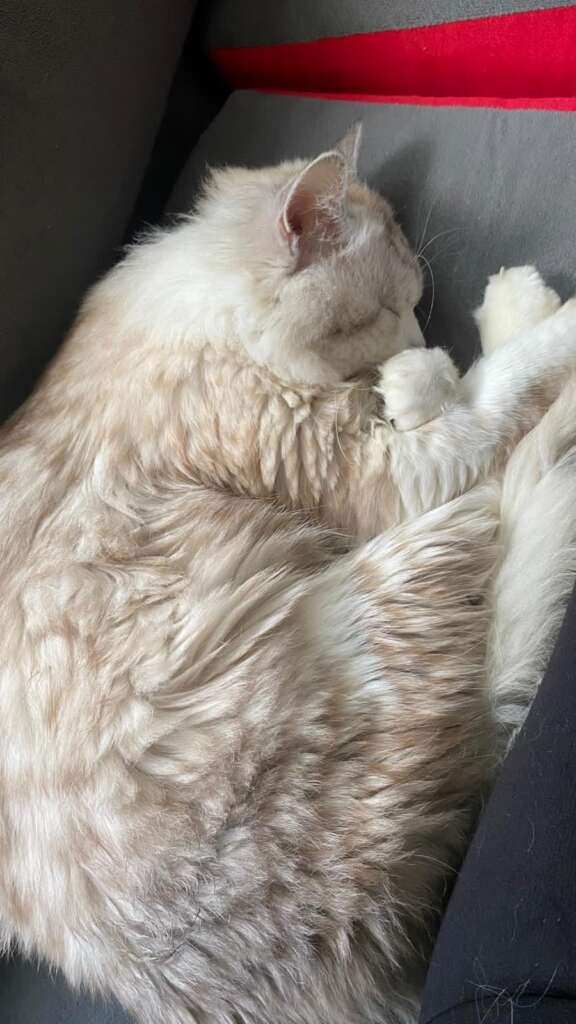
Unfortunately, my brother Mohammad was afraid of her. Although all children love cats, he preferred to watch from a distance. So, I never let her out of my room during the day unless I was with her.
Leo became my closest companion. I would spend hours with her, playing, talking, and confiding in her, as if I were speaking to my friend Yusuf, whose spirit and memories had never left me.
Days passed, and with each day, the war grew harsher, and the sounds of planes and repeated bombings increased… until an order came to evacuate the eastern areas and move west. Leaving the house and going into displacement was one of the hardest things for the soul, yet we believed it would only last a week or two, and we would return home soon.
I took only a few of my clothes and personal belongings, tidied my room, and photographed it on my phone in hope of returning soon. I saw in Leo’s eyes a look of pleading and fear, as if she understood what was happening and asked me silently, “Will you leave me?” She did not know that she was the most precious thing I had right now… and I would not leave her no matter what. I carried her in my arms and left with my family.
We decided to stay at my aunt’s house in the west, and I was worried about having Leo with us. My mother told me she did not want to feel embarrassed about her presence… we were in displacement and war, and things were hard. I told her I would not go without Leo, and if she insisted, I would go somewhere else.
When we arrived at my aunt’s house, I felt anxious inside, but as soon as we entered, her children jumped up, excited to see Leo, for she resembled their uncle’s cat, which he used to bring for them to play with. I looked at my aunt, and she smiled, telling her children, “Here comes another cat, go play with her.”
I breathed a sigh of relief, happy that everything had gone well. My aunt told me she was happier than her children, for she wanted them to occupy their time with something, hoping they would forget, even for a while, the harshness of the war.
Her children began trying to play with Leo along with my little brother Mohammad. He started to touch her gently, and his fear of her gradually decreased.
A week after staying at my aunt’s house, my grandmother asked me to go to the market to buy pasta for food. I entrusted Leo to my cousin and went. About half an hour later, I received a call from him, saying that Leo had attacked Mohammad and scratched him, and that he was crying, insisting on throwing her into the street. I ran back to the house, thinking I would never throw her away, no matter what.
As soon as I opened the door, I saw Leo sitting in Mohammad’s lap, playing with him, and the sounds of laughter filled the room—they had played a prank on me. I felt relieved and laughed along with them. Then my grandmother came and asked, “Where is the pasta, Hassan?”
It did not last long. Twenty days after staying at my aunt’s house, a new evacuation order came for the area, also heading west. We had no choice but to go toward the sea and the farmland in front of it. Like over one and a half million Palestinians, we went to a piece of farmland and rented 100 square meters to set up a tent for ourselves. We began again, searching for a new life in a new place, devoid of even the most basic necessities.
We built a tent for ourselves, a makeshift kitchen, and a simple bathroom. We tried to adapt to an existence that was one of the hardest things for the soul—to live breaths without a spirit.
Days passed, and we never forgot Leo, who seemed to like the place more. Here, sand was everywhere, and she could play and jump freely. She even found many other cats competing with her, for stray cats searching for food were abundant here.
As the days passed—some harsh, some slightly less cruel, and some in which we tried to create a little bit of happiness—life kept moving from bad to worse. Ever since our roof became nothing but cloth, even the simplest parts of daily life turned into a struggle for survival. An achievement became having a little clean drinking water, or being able to charge a phone.
By the beginning of July 2025, even securing a single meal became an accomplishment in itself. The closed crossings, along with the bombings and the targeting of anyone who moved, made it feel as if we were living in a sealed prison—we could not live freely, nor could we leave, and death surrounded us from every direction.
During that time, our faces began to change from the famine that seeped into every family’s tent. There was a shortage of everything, to the point that finding flour could cost you your life. We were not the only ones who suffered and changed—Leo did too. She had always eaten food made for cats, and when it disappeared from the markets, we began giving her some canned meat that she could eat, because she had become a member of our family. Whenever we had something she could eat, we would save a portion of our share for her.
But during that period, it was impossible to find anything—no meat, no dairy, nothing like what she used to eat before. Leo’s body began to change with the famine day after day. The only thing we occasionally had was a bit of bread. I tried several times to give her some, but she refused. I had never heard of a cat eating bread anyway.
And after things got even worse, finding even a small piece of bread became a challenge and a risk that could cost us our lives in Gaza by mid-July 2027. We reached a point where I could no longer walk long distances because of the lack of food. In the farmland where we lived, I stopped seeing Leo playing with me or running around in the sand. She had become a thin, weak cat who barely moved, surviving only on water.
Every night, I looked at her and felt something burning inside me—because I couldn’t provide her with anything, and because I felt that I could lose her at any moment. Whenever the situation became too heavy to bear, I would go sit by the sea, taking a breath with the sound of the waves… hoping they would distract me, even for a moment, from the noise of my empty stomach and the exhaustion of my heart.
One day, as I sat there, a small fishing boat approached the shore. On board were two fishermen who looked completely worn out. They couldn’t pull the boat out of the water or push it back in. Without thinking, my legs carried me toward them to help. I didn’t know if I had any strength left, but there was no one else around to assist them. After several attempts, we managed to pull the boat ashore. They had a few fish—small enough to count on one hand—and something I didn’t recognize at first. After looking closely, I realized it was a turtle, a reflection of how desperate life in Gaza had become.
I tried talking to them about helping with fishing daily in exchange for anything—anything that could feed my starving family, or at least Leo. The first fisherman didn’t object and said, “It’s fine with me.” The other said, “I won’t refuse, but you must know that when we enter the sea, we do it knowing we might not come back. Danger surrounds us everywhere. The moment we go in, we can be targeted by the occupation’s boats at any time. Some of our friends were killed, others were trapped and arrested, and no one knows their fate until now.”
He added that after all the restrictions placed on us, catching even a small amount of fish had become both an achievement and a challenge. Sometimes they caught nothing but turtles. They told me that if I wanted to accept their offer, I should be there the next morning at sunrise.
I returned to the tent thinking about their offer and the risk. But I had no other choice. I needed to bring something—anything—back for my family and for my cat. Even if it meant risking my life for them.
The next day, before the sun had fully risen, I walked toward the sea. My steps were heavy—not only because of hunger, but because of the question that pressed on me every second: “Will I come back?”
I found the fishermen waiting. Without much talking, we pushed the small boat into the water and began rowing. The surface of the sea looked calm in a deceiving way, while its depths felt like my own chest—filled with fear, memories, and the desperate desire to hold on to life in any way possible.
When we cast the nets, I wasn’t thinking about food alone. I was thinking of Yusuf… of the home that had turned into rubble… of the part of his soul that somehow lived through Leo… and of the question haunting me since that day:
“The war might calm down… but does anyone we lose ever come back?”
After hours, we pulled the net up. It was almost empty—only two tiny fish. I didn’t feel disappointed. On the contrary, for the first time in months, I felt something like achievement, something like life—something that Muhammad could eat, and something Leo might finally taste after so many days surviving only on water.
I returned to the tent, placed the two fish in front of my mother, and hugged Leo when she ran toward me with a faint sound. Her body was thin, but her eyes still said she was fighting with me, still giving me something that looked like hope. For the first time in a long while, I saw her eat happily, almost greedily. We didn’t get full that day—not even her—but it was a special day for my family in the middle of a famine swallowing an entire city.
I continued like this for days. Some days we were directly targeted by occupation boats. Some days we returned with nothing. And some days I came back with one or two fish—days that felt like victories to me.
After a while, with a few goods appearing in the market again, I was finally able to buy enough for my family, and I could even buy the canned meat Leo loved. I remember that in early September, it was the first time I managed to get those cans. She ate them all, and for the first time in months, I saw her play again. Deep inside, I kept wondering how she survived those brutal days—days that could return at any moment—while so many others couldn’t. It was as if she had chosen life.
Days passed, and Leo slowly began to recover.
And on October 9, when the ceasefire was announced, I felt something close to comfort for the first time. I thought—even for a moment—that the worst was over, that the pain might ease… that winter might be kinder.
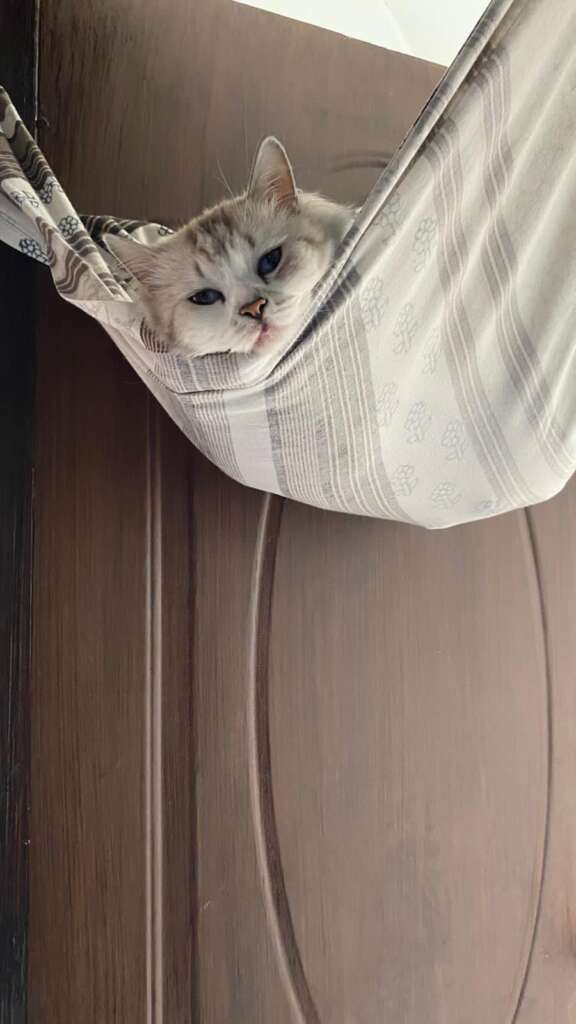
But winter… was not kinder.
Cold seeped into the tent through every hole. The wind tore at the fabric. Rainwater dripped above our heads. And because Leo had already become thin, she could no longer fight the cold like before. I kept her under the blanket, trying to warm her… but she shivered anyway.
And on one of those freezing nights…
I woke up and didn’t hear her voice.
I searched beside me, then near my mother, then in her usual corner…
She was lying quietly there. Her eyes half-closed. Her small body still, without a heartbeat.
She didn’t make a sound.
As if she didn’t want to bother anyone—not even when she left.
I sat on the ground… held her in my hands… and broke down. Something inside me cracked—something deep, something that couldn’t be fixed or stitched back together. She wasn’t just a cat… she was a piece of my soul in a time that tried to crush everything beautiful.
That day, I understood something:
The war may calm down…
The bombing may stop…
But those we lose…
Never come back.
And just as my soul had slowly healed when I found her… the pain found its way back to me again.
Like a constant update…
One that never stops…
And never shows mercy.
*************
Hassan Herzallah is a Gaza-based Palestinian writer and English translator focusing on life under siege and displacement in Gaza. His work has been published internationally and translated into several languages.
Note: This project is supported by the British Council as part of the SARD programme, which focuses on the role of English and other languages in building resilience. SARD – Stories of Adversity, Resilience and Determination – encourages Palestinians, particularly young people, to share their stories and lived experiences through creative and educational media. The content of this production is solely the responsibility of Resilient Voices and does not necessarily reflect the views of the supporting or partnering institutions.


1 Comment
Martin McMorrow
Well done for what you did and for what you wrote. This is a beautifully told, poignant, and touching tale. It purrs. Congratulations, Hassan.