



When I was in 8th grade, I met my best teacher, Sahar Shehada. She sowed seeds of love in my heart, not just teaching me the rules of English grammar. She taught me the deepest lesson: the teacher is what makes the students love or hate the subject. Life teaches me that “ to be teacher means to be a bridge of love and light to your students”
From that moment, I decided: when I teach children, I will be their special magic, and my classrooms will be full of joy and fun, transforming teaching from a burden into a passion.
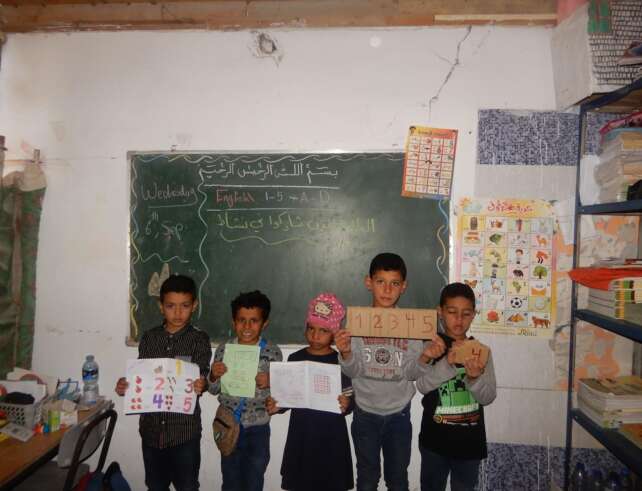
My journey began as a children’s English trainer, at “Unit” centre, which provided me with modern tools that enabled me to transform the classroom into a creative playground. However, during the genocide, it was impossible to have all the tools and toys.
Here, in the Al Amal neighbourhood, among the streets lined with demolished houses and needy faces, teaching English is no longer just a job; it has become an act of resistance—trying to smuggle children from their shattered reality into a realm of play and stories.
During the genocide, I worked with children to create educational methods that would mend what the Genocide had shattered in their souls. The task was not easy, but I put my best effort into it. Despite hunger and fear, my students taught me that childhood absolutely refuses to die in Gaza.
Ibrahim- A responsible boy
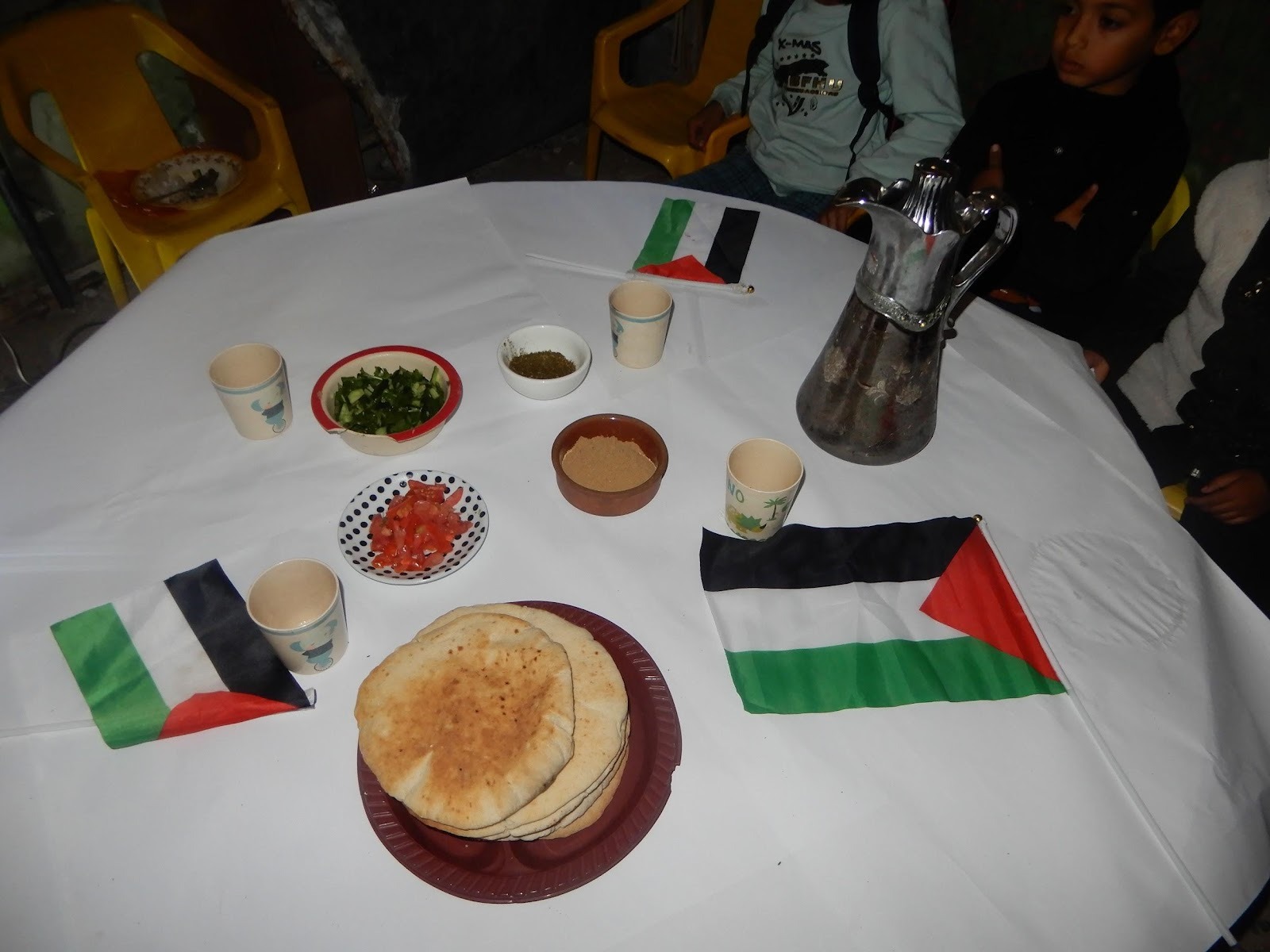
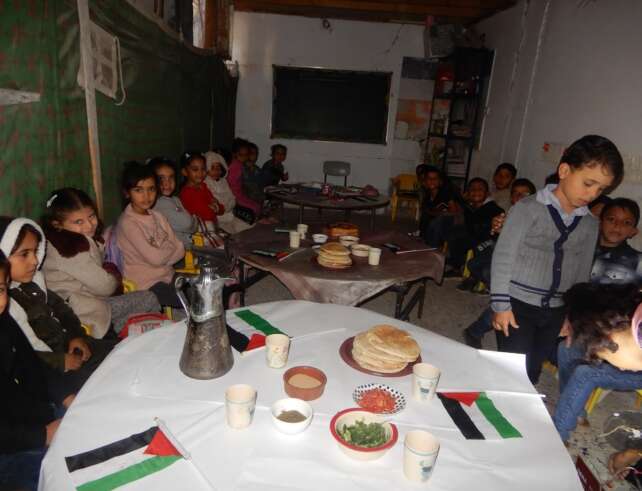
On World Children’s Day, November 20, 2024, while facing the famine, I decided to let joy fill children’s faces. I planned a collective Palestinian breakfast. I asked each child to bring whatever food they could from their home, as Gaza was experiencing its second famine at that time.
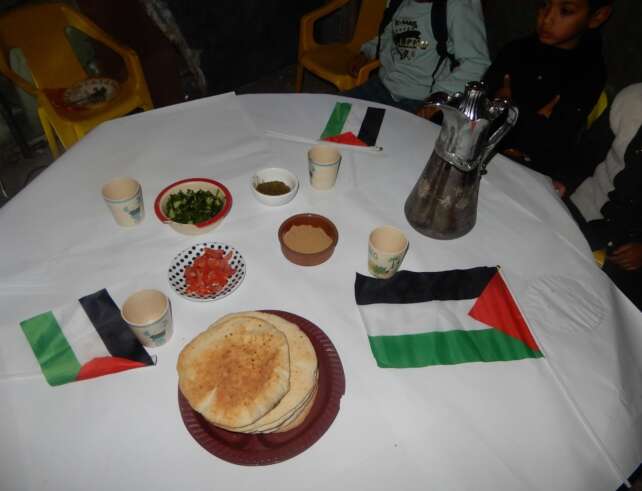
We spread the keffiyehs on the tables, and placed thyme, two hard to find tomatoes, tea, and bread. The bread was bad due to the lack of flour or flour that contained worms, but the place was filled with joy and happiness.
In the background, the song “Salam to Gaza” by the Palestinian singer from Gaza, Mohammed Assaf, played. My little ones were superheroes; Saba, Joudi, Suha, and Noor arranged the chairs, and Yahya and Marwan hurried back to bring the plates and teapot from their homes.
While I was tidying up the place, I overheard a conversation between Marwan, Ibrahim, and Abdulaziz.
Marwan asked, “Did you go to Takiyya today?” Abdulaziz replied affirmatively, but Ibrahim asked in surprise, “Did the people of Takiyya cook today?” He was referring to an improvised soup kitchen that some people had set up.
They responded, “Yes, they cooked.”
I overheard him whisper, “I want to tell the teacher that I want to go get some food from Takiyya, and then I’ll come back to class to share it.”
I felt a shock that shook my being. How could I respond to this request? Should I let him go out when it is unsafe, or deny him this rare meal?
I was thinking about how I would make a decision since they didn’t mention in the university textbooks how we would handle a situation like this!
Endless questions gnawed at me, but Marwan and Abdulaziz saved me by saying, “They already served all the food they had.” I felt a pain crushing my heart and a sorrow for their stolen childhood. How can we celebrate World Children’s Day while their childhood is being stolen before our eyes?
Marwan wants to be a bear!
I asked them to share their dreams for after the genocide with me .
Ryan said, “I want to become an engineer to rebuild our homes that were destroyed by the occupation.” While Zakaria said, “I want to become a doctor, to treat war victims and avoid the shortage of doctors.” And Yahya shouted, “I want to be a journalist like my father, to tell the world our stories and struggles.”
This was the will to live, until Marwan, ashort, quiet child, but a smile never left his round face and small green eyes, surprised us with his innocent remark: “I want to be a bear!” “I love eating a lot.”
Silence fell for a few moments, then the students burst into hysterical laughter. The laughter continued for several minutes. When I asked him about his favorite food, Marwan replied, “I love all kinds of food, but especially maftoul.” Maftoul is a popular Palestinian dish.
“I want to become an engineer,” says Rayan, his eyes glowing with enthusiasm, “to rebuild our homes that were destroyed by the occupation.” He draws me a blueprint of the home he had and explains how they will build a new house after the war, with his father, an engineer, helping him.
“I want to become a doctor,” says Zakaria, “to treat war casualties and not let there be a shortage of doctors during wars.”
“I want to become a teacher like my father,” says Iyad.
“I am a journalist like my father,” says Yahya, “to tell the world our stories and struggles.” The place erupted with laughter, and we started eating. At the end of the day, I gave each child a paper that said “Happy Child Day,” and each one drew their dream. We laughed a lot that day, and that laughter was our small victory over the misery of the ongoing war.
“I love Miss Donya”
I have always believed in the power of education through games and stories, especially in these harsh conditions that require me, as a teacher, to also be a psychological therapist. My work with the children for six months during the genocide, inventing new ways to teach them, was an attempt to compensate for loss and fear.
But my greatest reward was not in a salary or a certificate, but in a heartfelt message I received from Salah’s mother on November 1st. She was asking about his academic performance, and then she surprised me:
“I’ll tell you a secret.” Salah says he loves Miss Donya. What is she doing to him?
These words, for me, were life. The mother told me that this was the first sentence Salah spoke clearly after months of silence! He suffered a severe psychological shock when the IOF arrested his father in front of him at the Red Crescent. Whenever he remembers the scene, he cries. After the father’s arrest on February 5, 2024, the mother says:
“Saleh has become silent, doesn’t listen to her, is stubborn, and has started wetting himself…” He became irritable, and whenever he got angry, he would bite himself or his clothes.
Imagine a 9-year-old child watching tanks and soldiers, seeing his father being arrested, witnessing bodies on the ground, and being forced, along with his mother, to cross roads of death.
For a child like this, who has suffered a severe trauma, to say to me, “I love the world,” means that I have succeeded. I succeeded in being that light in the darkness of war. I succeeded in using English not as a curriculum, but as a tool to restore the lost spirit and to plant a seed of safety and confidence in a small heart torn by fear.
Note: This project is supported by the British Council as part of the SARD programme, which focuses on the role of English and other languages in building resilience. SARD – Stories of Adversity, Resilience and Determination – encourages Palestinians, particularly young people, to share their stories and lived experiences through creative and educational media. The content of this production is solely the responsibility of Resilient Voices and does not necessarily reflect the views of the supporting or partnering institutions.

1 Comment
gurbe van belle
A beutiful story, Miss Donya!
the road to mending the hurt souls of the children will be long, and providing them with what small safe spaces you can is só important! Meanwhile we pray and fight for the Occupation to leave your stolen land. Soon, we hope!